
Applied AI / Process design
The bottleneck comes before the bot.
Before I ask what AI can do, I want to know where the work is getting stuck.
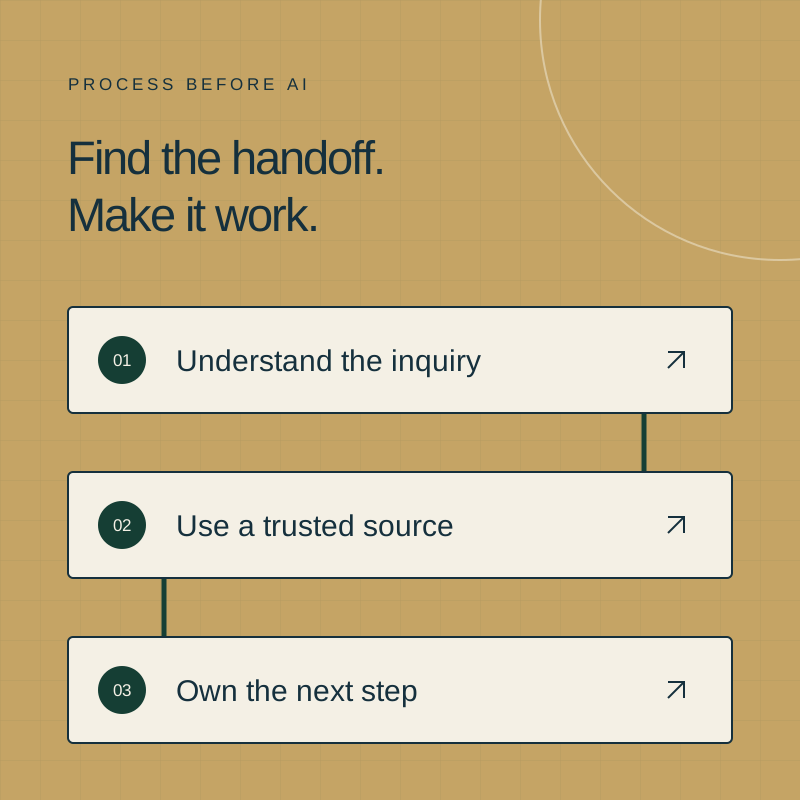
Make the unfinished work visible
Work on service websites and resource planning keeps bringing me back to the same question: what is the next useful action, and what makes it hard for someone to take it? A page may look finished while the path from interest to a conversation still needs work. An educational resource may be well written while nobody owns its distribution.
AI can help produce copy, compare alternatives, organize a plan and build an interface. Those are useful capabilities. But producing more material is not the same as resolving the unfinished handoff. If the business has not agreed who receives an inquiry or what happens next, faster content production leaves that ambiguity in place.
That is why I would begin with the process in ordinary language: a person arrives, tries to understand the offer, decides whether it fits, and takes a next step. The business then needs to respond. Each transition has a question, a source of information and an owner.
Give the AI one job with a clear edge
Consider a service-business inquiry. A bounded AI task might be to turn approved service information into a first-visit checklist. The input is known. The audience is specific. The output can be checked. The person accountable for the service can verify that the checklist reflects what will actually happen.
A much broader request, such as “automate the customer journey,” bundles several decisions together. It can blur the difference between drafting an answer, approving it, sending it and making a commitment on the business’s behalf. I would separate those steps before deciding which to automate.
My working sequence is: name the friction, locate the reliable information, assign the owner, define the permitted action, and decide how to check the result. This is an operating method I propose, not a promise that every task needs an AI component. Sometimes the useful change is a clearer page, a shorter form or a named person responsible for a response.
Connect the promise to the operation
In resource planning, I have worked through a sequence that moves from an introductory decision guide to a more focused topic and then to preparation for a first appointment. The lesson is about continuity: each piece should answer the next question, and the final step should match the real service. Planning those resources does not establish that they have been published or that they have improved conversion.
That distinction also matters when improving a booking page. I can inspect the page, test its buttons and verify that it works at different screen sizes. Those checks tell me something important about the implementation. They do not tell me whether more qualified customers booked afterward.
A brand promise, an interface and an internal process should agree. If the website promises an easy next step but the team receives incomplete information, the work is only partly done. I want AI to help connect those parts, with the people responsible for the service shaping the rules.
Test the handoff, not just the output
For a small pilot, I would write down the current problem before changing anything. Perhaps inquiries repeatedly arrive without the details needed for a useful reply. The proposed improvement might be a clearer preparation prompt or an AI-assisted draft that organizes the information already provided.
Then I would choose a limited trial, a reviewer and a few relevant checks: does the information stay accurate, can the reviewer correct it quickly, and does the next person receive what they need? If measuring time or booking behavior, define the baseline and the period before claiming improvement. A small sample may be informative without proving a lasting effect.
Keep the previous process available during the trial. If errors create more work, narrow the task or remove the automation. A tool has to earn its place in the workflow. The attractive demo is the beginning of that assessment.
Keep leadership in the loop
The leader’s contribution is to connect the customer’s experience with the work behind it. That requires listening across functions, noticing where a responsibility changes hands, and being explicit about the outcome that matters.
My interest in AI comes from that practical work. I want it to help a business see a problem more clearly, build a workable response and learn from the result. The process defines the job. The tool should make that job easier to do well.
Name the friction. Agree on the source and owner. Run a small test. Measure the handoff before claiming progress.
A perspective on practice. Examples describe observed work or proposed approaches; no measured business improvement is claimed.