
AI / Judgment & stewardship
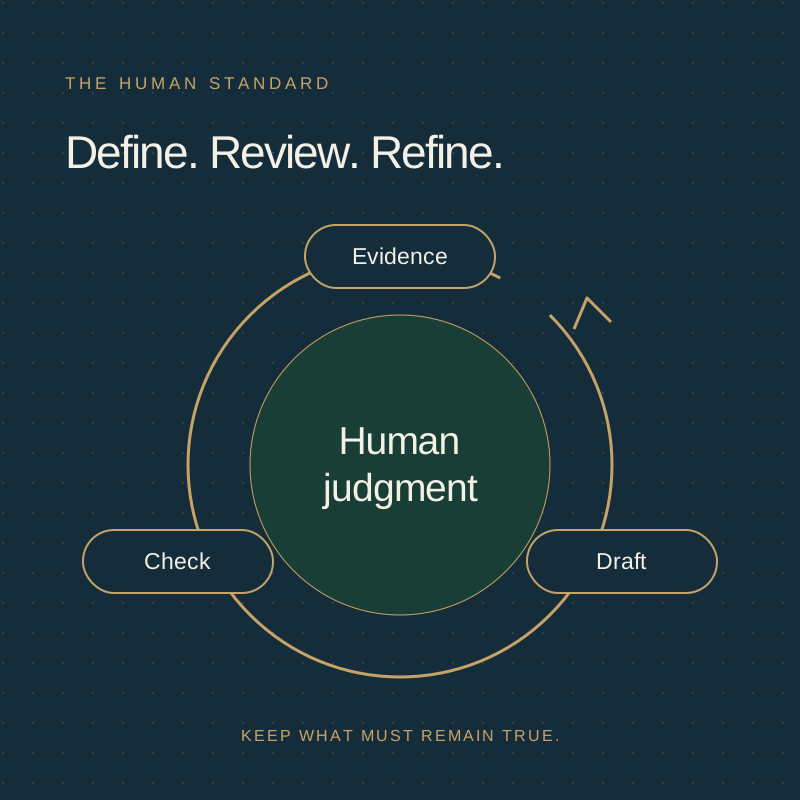
The human job is to define what good looks like.
The most useful instruction I gave an image tool was eventually to stop reinventing my face.
A polished result can still be wrong
While building my website, I repeatedly asked for images that looked more like me. Some results looked convincing at a glance and less convincing when enlarged. I could see the difference even when it was difficult to describe exactly which detail was wrong.
Eventually I asked to return to the original photograph and make the face clearer. When the choice was framed as using the original pixels with limited adjustments, I approved that approach. The requirement had become more precise: preserve the person in the photograph, then improve the presentation.
That experience changed the question I was asking. “Make this more realistic” left too much open. “Keep the original face; adjust only clarity and exposure” defined what success would preserve. It was a lesson for me and for the assistant: repeated dissatisfaction should prompt a change in method, not another variation of the same attempt.
Define what must survive the edit
Most business work contains details that must stay fixed. In a photograph it may be a face. In a proposal it may be the price. In an analysis it may be the meaning of a metric. In a website it may be the destination of a booking button.
I now think of a useful brief as a combination of intention and invariants: what should improve, and what must remain true? The word “invariant” sounds technical, but the practice is simple. Name the few details that would make the output unusable if they changed.
For my site, those details include an approved brand mark, an exact tagline, identifiable photographs and links that lead where they say they do. A better composition does not compensate for getting those details wrong. They are part of the definition of good work.
Turn taste into a checkable instruction
Visual annotations have been useful because they give feedback a location. “Move these two photos until their bottom edges align with the button” is easier to assess than “make the section feel tighter.” Both describe a preference, but the first creates an observable finish line.
The same approach works with writing. Instead of asking to sound more authoritative, I can ask for a clear argument, an example from work I have actually done, the limits of that example, and a practical implication for a leader. That produces a stronger standard than a more confident tone.
The standard also has to survive across revisions. Once a tagline or image is approved, it belongs in the project’s decision record. Otherwise every new request risks reopening an old decision. Long conversation history is useful context, but a short record of the current choices is easier to inspect.
Ask for evidence of completion
A website change is not complete because the assistant describes it well. I want to see the page, the relevant crop at a useful size, and the layout on a phone as well as a desktop. If a link or form changed, I want its behavior checked. The evidence should match the thing that could fail.
For an article, that means separating personal experience from a general claim. For a business calculation, it means naming the inputs and assumptions. For an automation, it means testing a normal case and a case where the information is missing or wrong.
These checks do not make an AI system infallible. They give people a way to notice errors before relying on the output. I would also keep an original copy and a straightforward route back when changing something important. Verification is easier when the result can be compared with a known starting point.
Steward the consequences
I can be playful in how I talk to AI and still be disciplined about what I trust it to do. The stewardship I care about is practical: what information enters the system, what it is allowed to change, who reviews the result and who is affected if the result is wrong.
That means giving an assistant enough room to complete a clearly defined task, while keeping meaningful commitments explicit. Drafting a message and sending it are different actions. Preparing a site and publishing it are different states. Creating an analysis and proving a business outcome are different achievements.
The human role is to bring context, standards and accountability. The assistant should contribute useful work and make uncertainty visible. When those responsibilities are clear, the collaboration becomes easier to improve: fewer repeated corrections, more traceable decisions, and outputs that can stand up to inspection.
Be specific about what must remain true. Keep approved decisions visible. Verify the result in the form people will actually use.
A perspective on practice. Examples describe observed work or proposed approaches; no measured business improvement is claimed.